Stamping and drawing compound
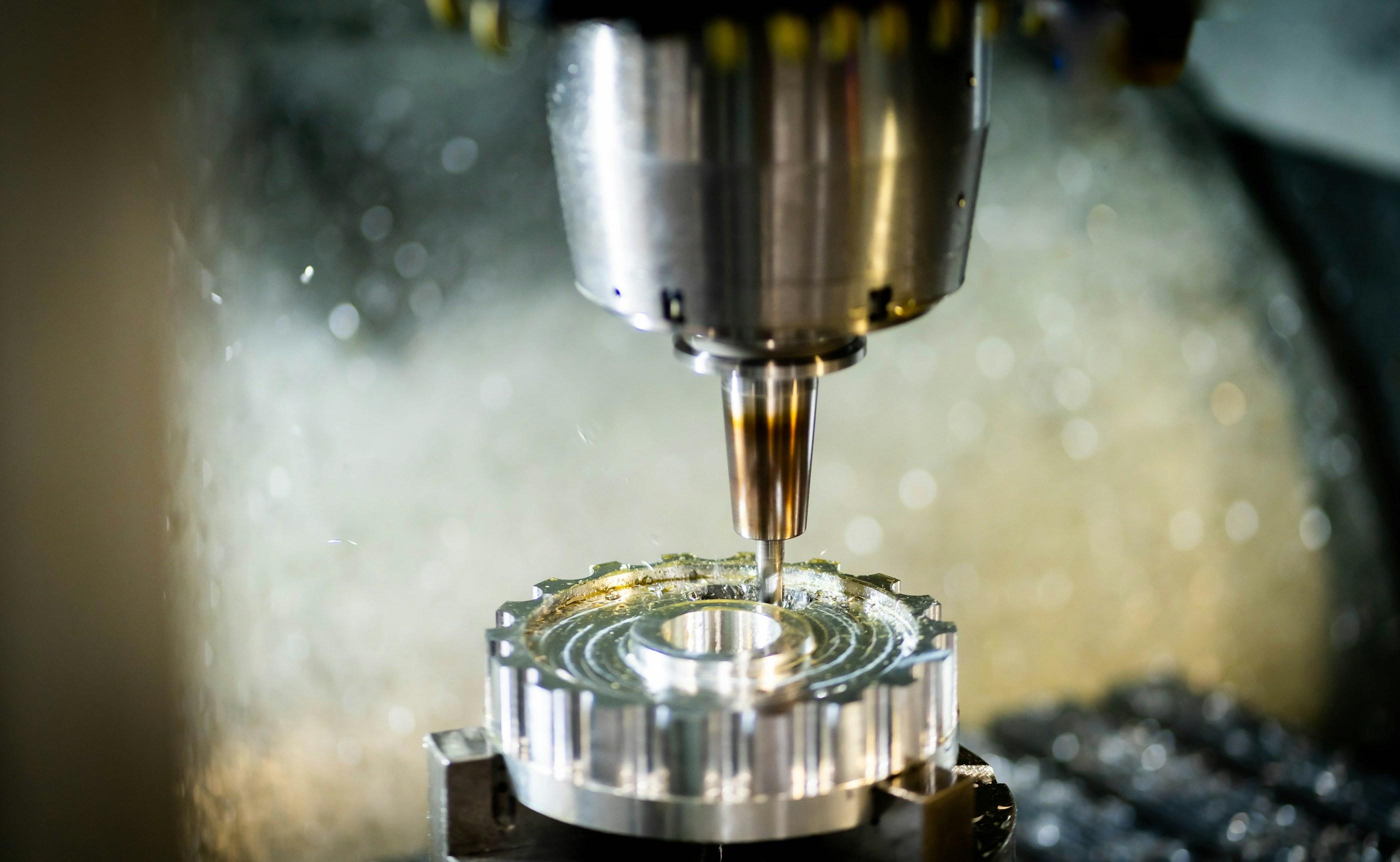
The heavy forming lubricants — stamping oil, drawing compound, deep-draw soap and forming paste — left on pressed, drawn, deep-drawn and cold-headed parts.
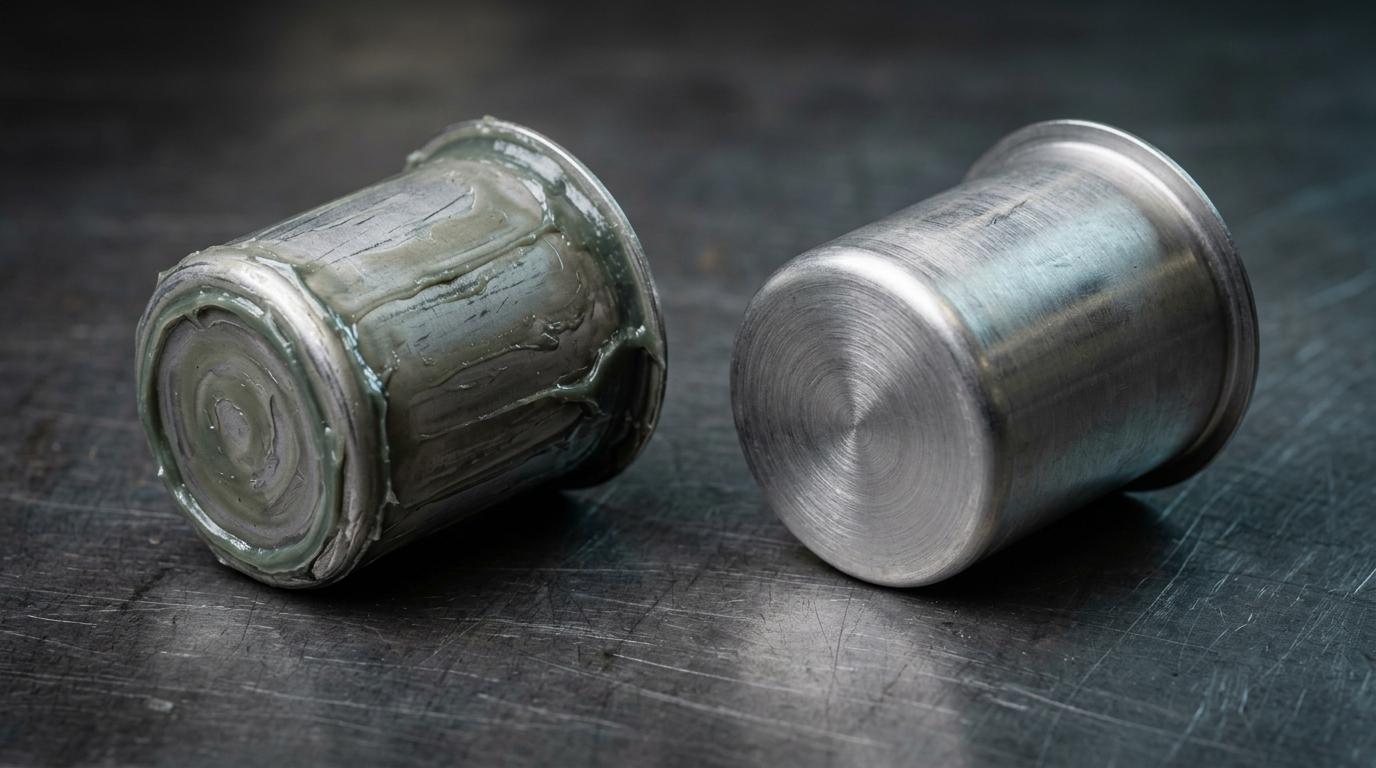
Stamping and drawing compounds are the heavy, additive-loaded lubricants that let sheet metal deform without tearing. They are viscous by design, cling in draw radii and thread roots, and oxidise into varnish if heated. Ultrasonic cleaning at 28 to 40 kHz in a hot alkaline degreaser removes them before plating or welding.
- Recommended frequency
- 28 / 40 kHz
A forming lubricant is not a cutting fluid with a different label. A cutting fluid mostly has to cool and flush; a forming compound has to survive contact pressures high enough to make steel flow, without letting the tool and the blank weld to each other. That is achieved with high viscosity, high additive loading — chlorinated paraffin, sulphurised fat, soap, sometimes a pigmented filler — and, in deep drawing, with compounds that are solid or waxy at room temperature and only spread under pressure.
Everything that makes it work makes it hard to remove. It is thick, so it bridges rather than drains. It is designed to stay put under pressure, so a spray jet does not shift it. It fills the exact geometry the forming operation created — the draw radius, the burr edge, the fold of a hemmed seam, the root of a rolled thread, the inside of a deep-drawn shell — and it holds the metal fines the operation shed at the same time. On a progressive-die part that has been through eight stations, the compound in the last drawn feature has already been worked, heated and partly polymerised.
The consequences are all downstream and all expensive. Plating is the usual one: electroplating and electroless plating both need a chemically clean, uniformly wettable surface, and a patch of drawing compound in a radius becomes a skip, a blister or a plated-over inclusion that fails salt-spray. Welding and brazing over it gives porosity. Painting and powder coating give craters. Any subsequent heat — a weld cycle, a bake, a heat treatment — turns residual compound into a carbonised varnish that no longer responds to a degreaser at all, and has to be attacked as an oxide-and-carbon problem instead. Cold-headed fasteners carry it into the thread root, where it stops a torque specification from meaning anything.
Ultrasonic cleaning works here because the soil is thick and the geometry is closed. A hot alkaline degreaser saponifies the fatty and soap components and emulsifies the mineral fraction; cavitation supplies the mechanical work to break a viscous film that would otherwise simply sit under the wash. Temperature matters more than usual — a compound that is waxy at 30 °C is fluid at 60 °C, and the bath is the only part of the process that can make that change. Frequency follows the part: pressed steel brackets, deep-drawn shells and cold-headed fasteners take 28 kHz, while stamped terminals, lead-frames, thin conductive parts and small medical components run at 40 kHz.
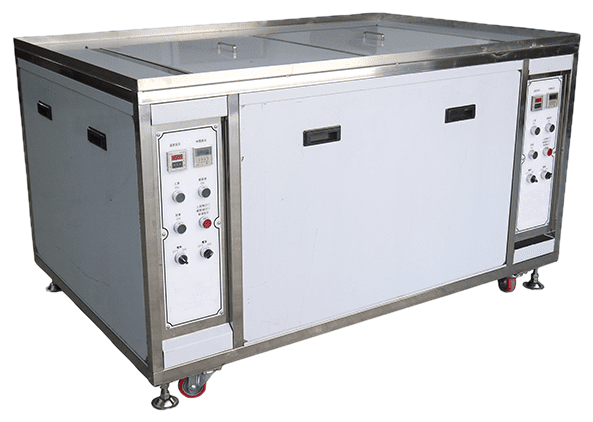
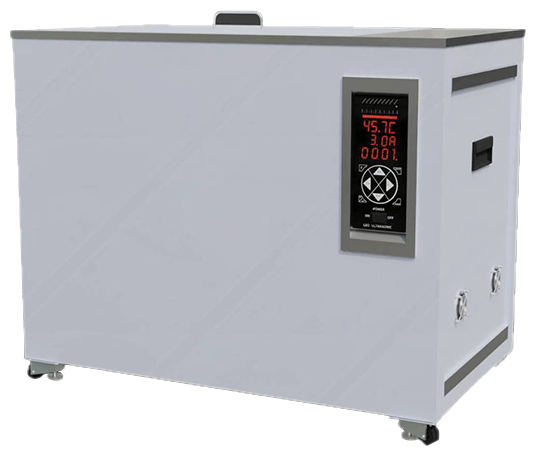
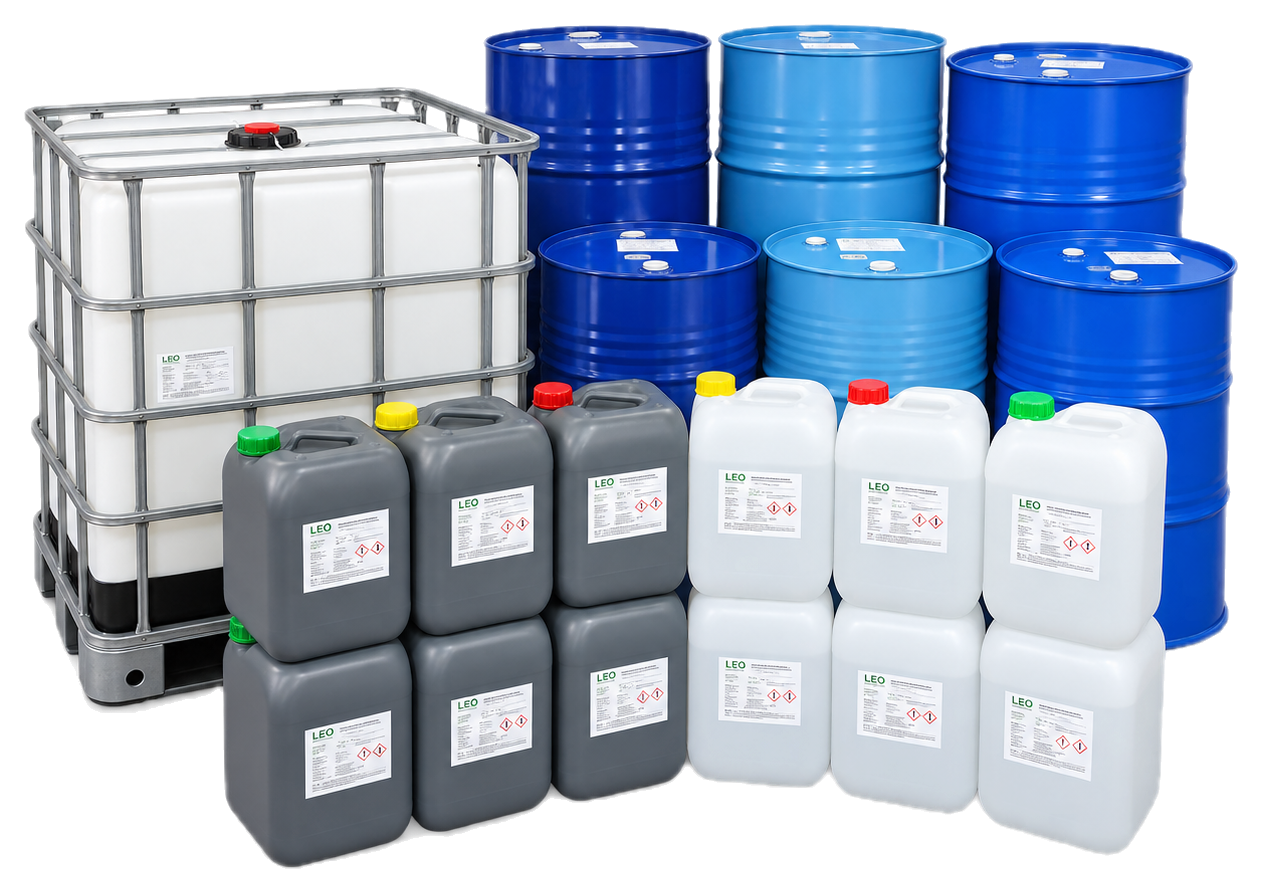
For plating lines the cleaning step is not a finishing step, it is the first step of the plating process, and it is specified that way. LEO’s industrial tanks were built for that duty from the beginning — the double-tank and automatic-lifting series list cleaning of plate parts before plating as their scope of application — and the in-house cleaning-agent range includes both the water-based degreasers this soil needs and the rust preventives that have to follow them on bare steel.
Process
The process chain
- Step
Hot pre-soak to soften the compound
Deep-draw compounds are waxy or solid at room temperature and will not move until they are warm. A hot alkaline soak before the ultrasonic stage turns the film fluid so that cavitation has something it can actually shear, and takes the bulk load off the main bath.
- Step
Ultrasonic wash in a hot alkaline degreaser
A water-based degreaser at 55–70 °C saponifies the soap and fatty fraction and emulsifies the mineral oil, while cavitation lifts the film out of draw radii, hemmed seams and thread roots and releases the metal fines held in it.
- Step
Cascade rinse to break the drag-out chain
Alkaline carried into a plating line is a bath contaminant in its own right. A counter-flow cascade rinse takes the degreaser concentration down by orders of magnitude across two stages, using far less water than a single rinse of the same effectiveness.
- Step
Acid activation or rust-preventive, by destination
A part going straight to plating gets an acid activation dip so it enters the bath with a chemically active surface. A part going to stock or to a later operation gets a rust preventive instead — bare drawn steel flash-rusts within minutes of a clean aqueous rinse.
- Step
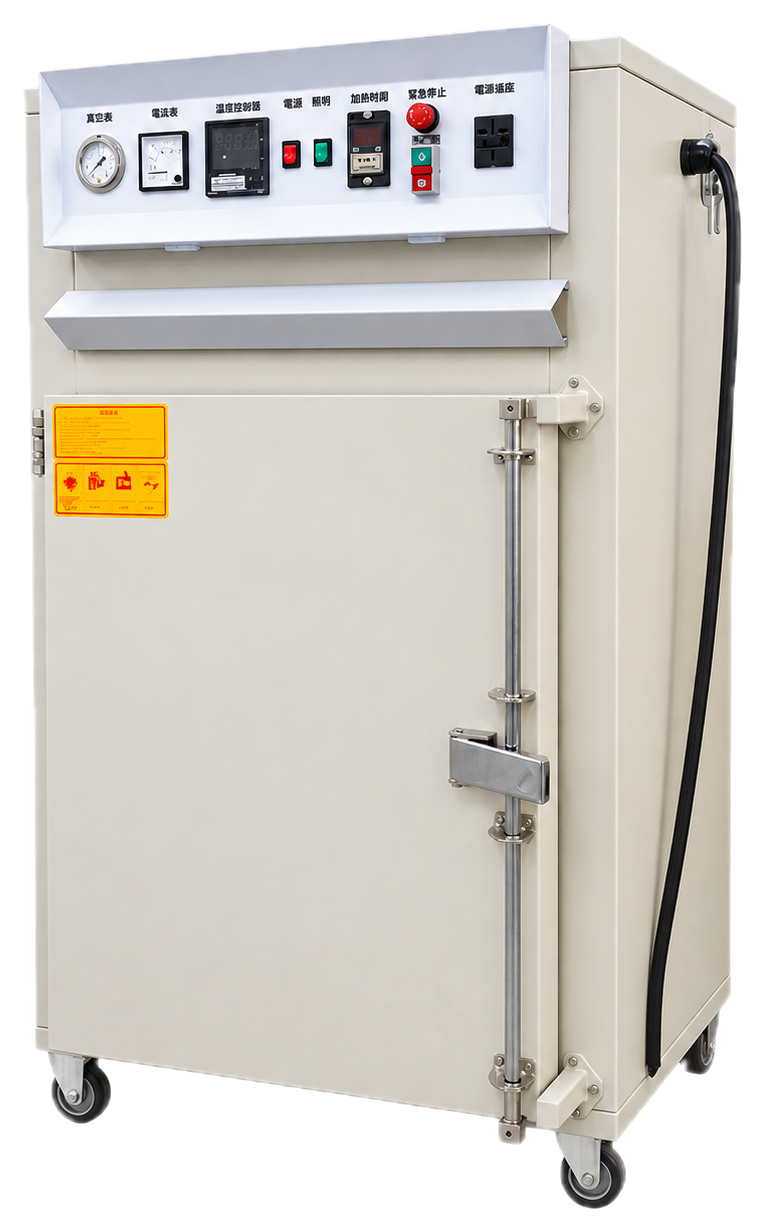
Hot-air dry before packing or plating
Deep-drawn shells and nested stampings hold water in the cup and between faces. Heated circulating air, with baskets loaded so the geometry can drain, is what stops water spotting and interleaf corrosion in a packed carton.




Frequently asked questions
Because the chemistry and the temperature are different. Cutting fluid is usually a thin oil or an emulsion that a warm degreaser handles. Forming compounds are viscous, heavily loaded with soap, chlorinated paraffin or sulphurised fat, and some are solid at room temperature. They need a hotter bath, a more strongly alkaline chemistry and longer contact. Running them through a cutting-fluid recipe leaves a residue in the draw radii, which is exactly where plating then fails.
Usually, and the location tells you. Skips that repeat in the same feature on every part — a draw radius, a hem, one face of a bend — point at forming compound the wash did not reach, not at the plating bath. Skips that move around point at rinse water or handling. The cleaning fix is heat, chemistry and cavitation at the feature, plus a cascade rinse so the alkaline drag-out does not disturb the plating bath itself.
It can, but not as a degreasing job. Once a forming compound has been baked it is no longer an oil — it is a polymerised, partly carbonised varnish, and an alkaline degreaser barely touches it. It has to be treated the way carbon deposit and oxide are treated, with a chemistry chosen to attack the carbonised film and a longer, lower-frequency ultrasonic cycle. The cheaper answer is to clean before the heat, not after.
Request a Quote
Tell us what you need cleaned
Send us the part, the contaminant and your cycle time. Our engineers size the tank, the frequency and the process chain — and reply with a sized specification for your line.