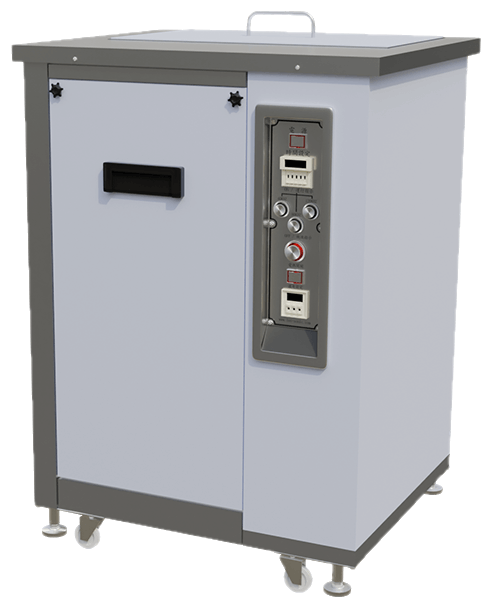
Particulate and metal fines
Loose solid contamination — metal fines, swarf and burr debris, glass and silicon dust, trapped powder, abrasive grit and airborne dust — held on the surface by physics rather than chemistry.
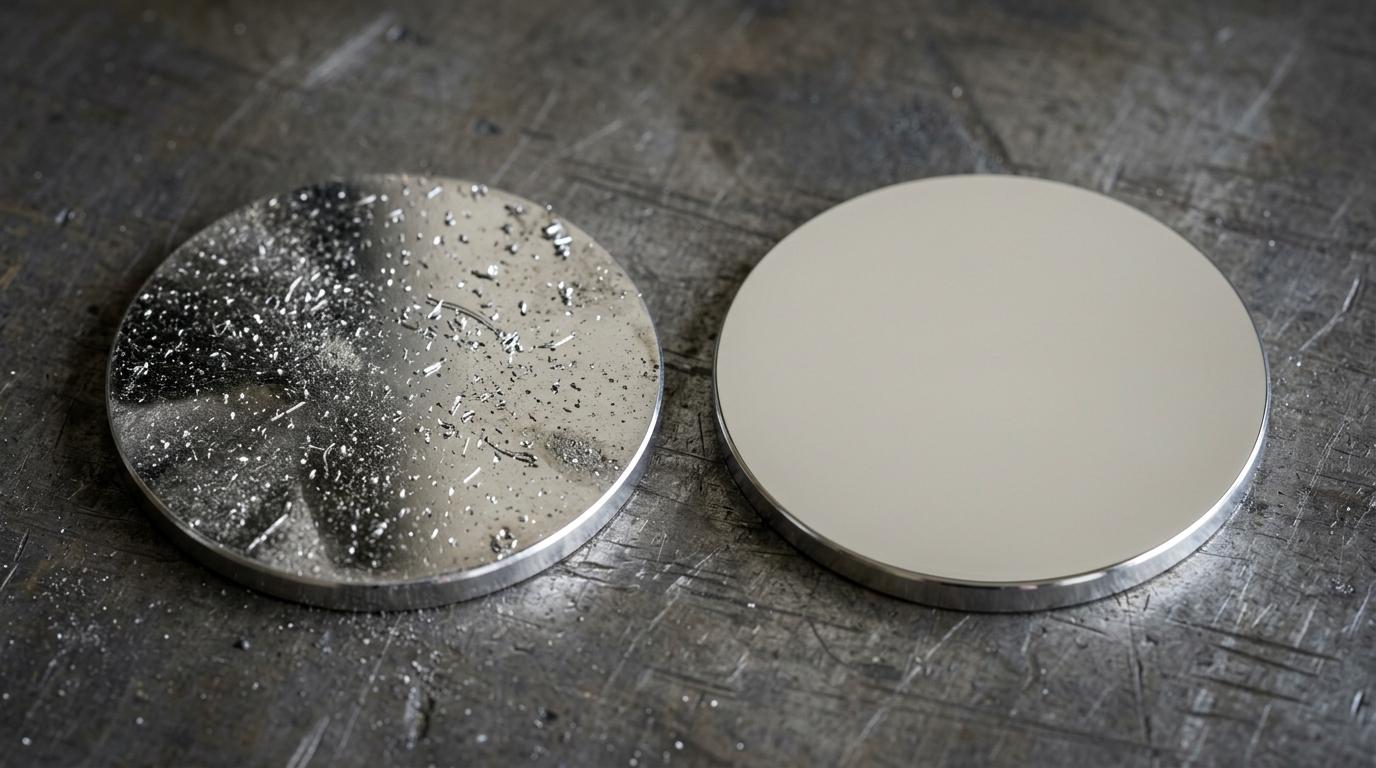
Particulate contamination is loose solid matter — metal fines, swarf, glass and silicon dust, abrasive grit — held on a surface by static charge, surface tension and geometry rather than by chemistry. Nothing dissolves it. High-frequency ultrasonic cleaning at 80 to 120 kHz lifts particles and filtration takes them out.
- Recommended frequency
- 80 / 120 kHz
Every other application on this site is about a film. This one is about objects. A particle is not attached by chemistry, so there is no chemistry that removes it: it is held by van der Waals attraction, by electrostatic charge, by the surface tension of a residual liquid film, and — most stubbornly — by geometry, when it has simply fallen into a hole it cannot fall out of. That difference decides the whole process. Cleaning a particle means detaching it, transporting it away from the surface, and then getting it out of the bath, and a process that does the first two but not the third just moves the contamination to the next part.
Detachment gets harder as the particle gets smaller, which is the opposite of most intuitions. Adhesion force falls roughly with the particle’s diameter, but the force needed to pull it out of the boundary layer at the surface falls much faster, so sub-micron particles are the hardest of all to remove. Flow does not help: at the wall the liquid velocity goes to zero, and a particle sitting inside that stagnant film is not exposed to the flow you can see. This is why washing, spraying and blowing all plateau at some particle size and stop improving.
The consequence of leaving particles behind is usually not visible and always expensive. A metal fine in a hydraulic valve, a bearing race or a fuel gallery is the initiating particle of a field failure, which is why automotive and aerospace cleanliness is specified as a particle count and a gravimetric residue rather than as an appearance. On a wafer or a photomask a single sub-micron particle is a killed die. On an optical surface a particle scatters light, and if it is trapped under a subsequent coating it becomes a permanent defect. In additive manufacturing, powder trapped in a conformal cooling channel or a lattice is both a contaminant and, in some materials, a genuine safety issue. In electronics, conductive metal fines between adjacent traces are a latent short.
Ultrasonic cleaning works on particles for a reason specific to this soil. Cavitation and the acoustic microstreaming around a collapsing bubble disturb the boundary layer itself — the stagnant film that shelters the particle — and once the particle is out of it, streaming carries it away. The thickness of that acoustic boundary layer falls as frequency rises, roughly with the inverse square root of frequency, which is the physical reason high frequencies remove smaller particles: at 120 kHz the layer is about half as thick as at 28 kHz, so the same cavitation reaches particles that low frequency simply cannot touch. Low frequency has more energy per bubble, but its energy is delivered further from the surface, and it risks eroding the very surfaces this duty tends to involve.
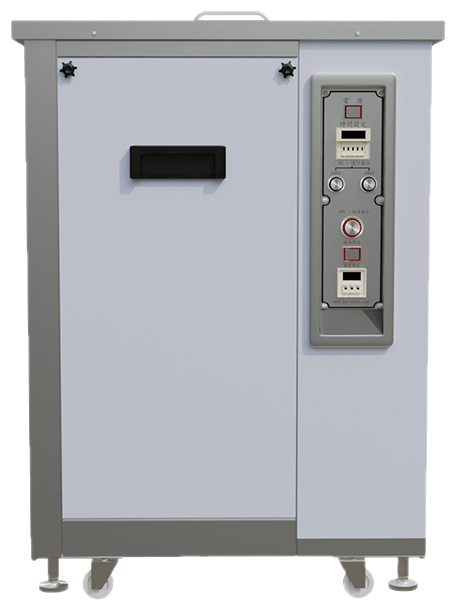
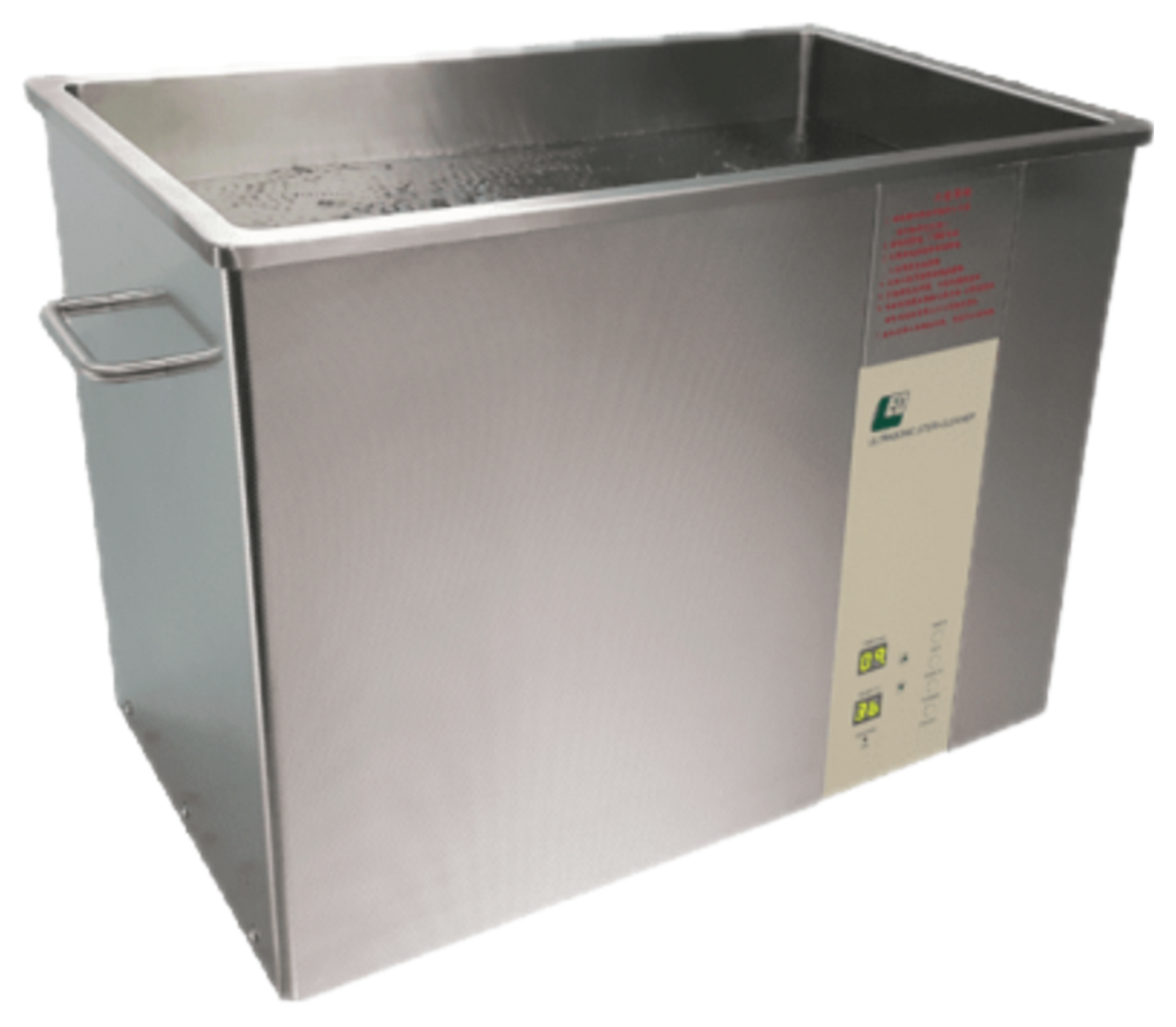
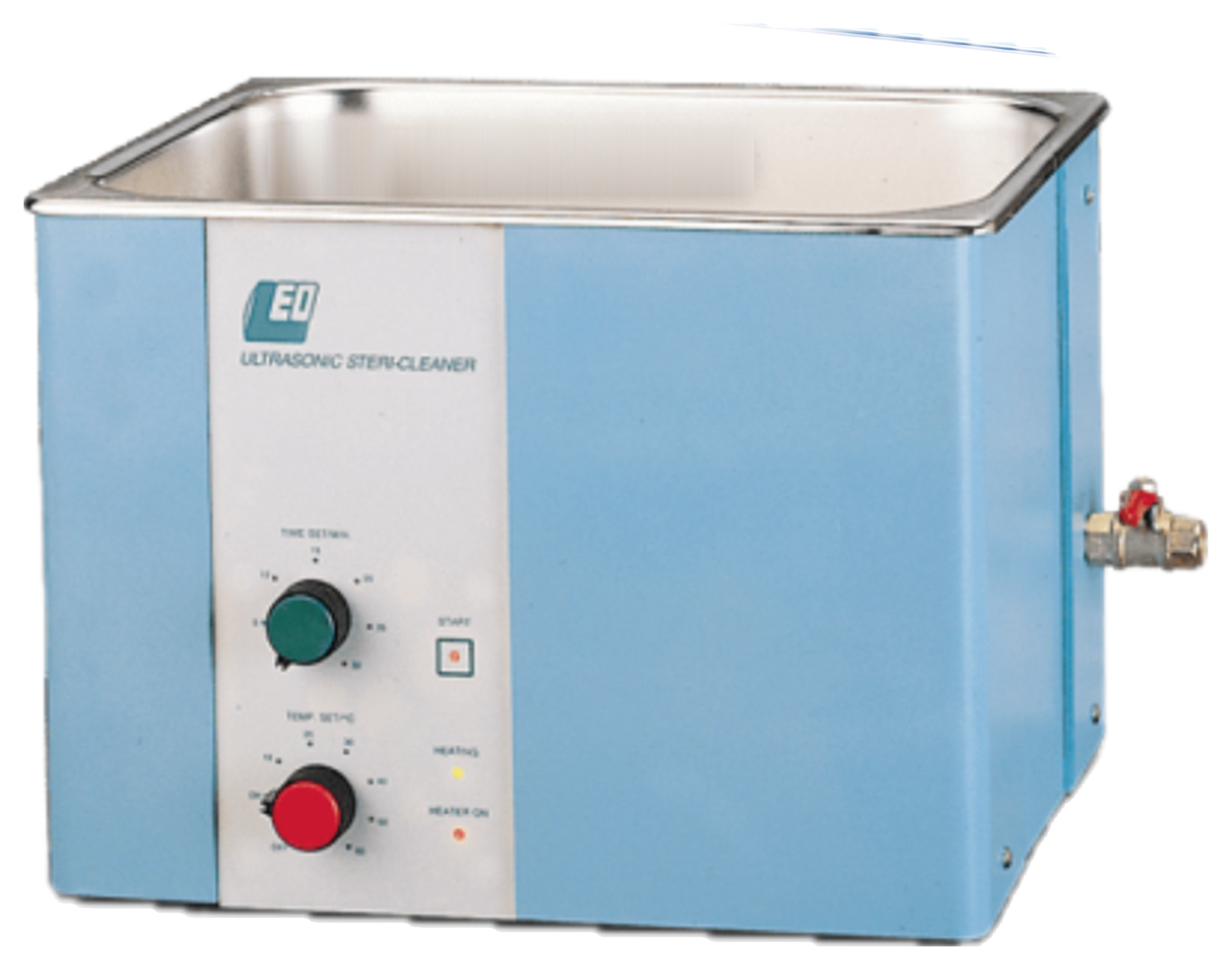
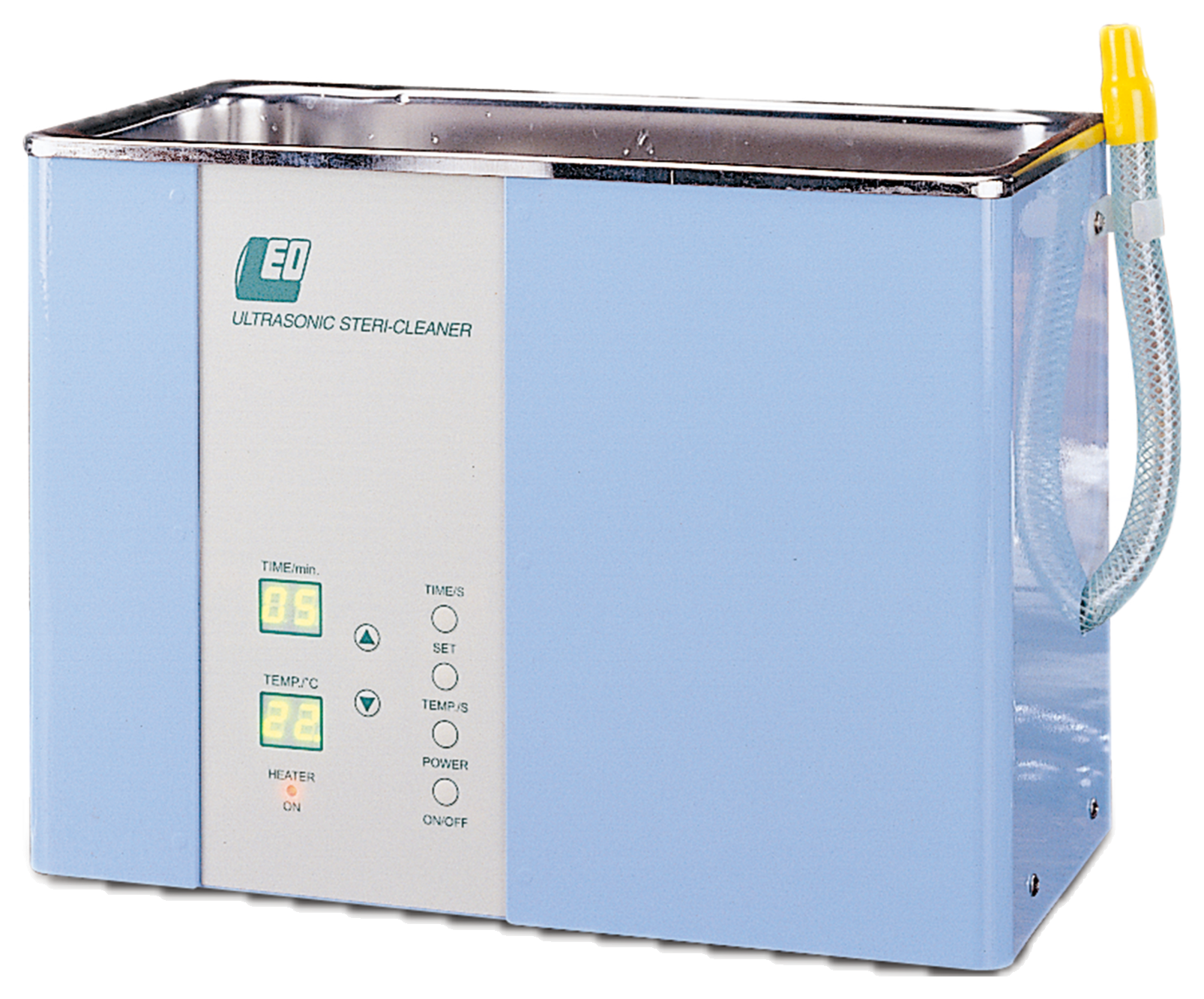
Filtration is not an accessory here, it is half the process. Every particle removed from a part is now in the bath, and a bath without adequate flow through a filter fine enough for the particles concerned re-deposits them on the next basket. The same applies to the rinse: the final rinse water has to be cleaner than the specification you are cleaning to, which for fine work means treated water and a cascade. LEO builds dual- and three-frequency tanks spanning 28/40, 40/80 and 40/120 kHz, and the three-frequency series covering 40, 80 and 120 kHz exists precisely so that a plant can put heavy soil and sub-micron particle removal on the same machine without compromising either.
Process
The process chain
- Step
Remove the film first
Particles are usually held by an oil or coolant film, and while that film is there no amount of high-frequency cavitation will release them. A degreasing stage comes first; particle removal is a second, separate operation working on a surface that no longer has anything sticky on it.
- Step
High-frequency ultrasonic wash at 80–120 kHz
The acoustic boundary layer thins as frequency rises, so high frequency reaches particles that low frequency cannot. Cavitation and microstreaming detach them and carry them clear of the surface — which is the whole mechanism, and it does not work through a spray.
- Step
Continuous filtration on the wash tank
Every particle taken off a part is now in the bath. Flow through a filter rated for the particle size concerned is what stops the tank re-depositing this basket’s contamination onto the next one. Without it the process removes particles and then gives them back.
- Step
Cascade rinse on treated water
The final rinse water has to be cleaner than the cleanliness class being worked to, or it becomes the contamination source. A counter-flow cascade on treated water means the last liquid the part touches is the cleanest in the machine.
- Step
Dry without re-contaminating
A dry part carries static charge and will pull airborne dust straight back onto itself. Drying in filtered heated air, and packing immediately in a controlled area, is what preserves the result — a part cleaned to a particle count and then left open on a bench is not clean any more.


Frequently asked questions
Because the force holding a particle falls more slowly than the force available to remove it. Adhesion scales roughly with particle diameter, but a small particle sits entirely inside the stagnant boundary layer at the surface, where the liquid velocity is effectively zero — so the flow that would sweep away a large chip never touches it. Removing sub-micron particles means disturbing the boundary layer itself, which is what high-frequency cavitation and acoustic microstreaming do and what spraying and blowing do not.
Yes, and it is the most common reason a particle-removal process fails to hold its result. Everything taken off a part goes into the bath and stays there until something removes it. Without adequate flow through a filter matched to the particle size, the tank reaches an equilibrium where it deposits about as much as it removes, and the symptom is a process that worked when the bath was new and drifted afterwards. Filtration is sized as part of the machine, not added to it later.
Not always. Packed swarf in a cross-hole or a thread root is a mechanical obstruction, and 28 or 40 kHz shifts it far better than 120 kHz will. The usual arrangement is both: a lower-frequency stage to clear bulk debris and break the oil film holding it, then a high-frequency stage for the fine and sub-micron fraction. That is the reason LEO builds multi-frequency tanks — 28/40, 40/80, 40/120 and a three-frequency 40/80/120 series — rather than expecting one setting to cover the whole range.
Request a Quote
Tell us what you need cleaned
Send us the part, the contaminant and your cycle time. Our engineers size the tank, the frequency and the process chain — and reply with a sized specification for your line.