
Carbon deposit and coking
The baked-on carbon, coke, varnish and fuel gum that forms wherever oil, fuel or polymer is held hot — injectors, pistons, turbine parts, mould vents and cooking surfaces.
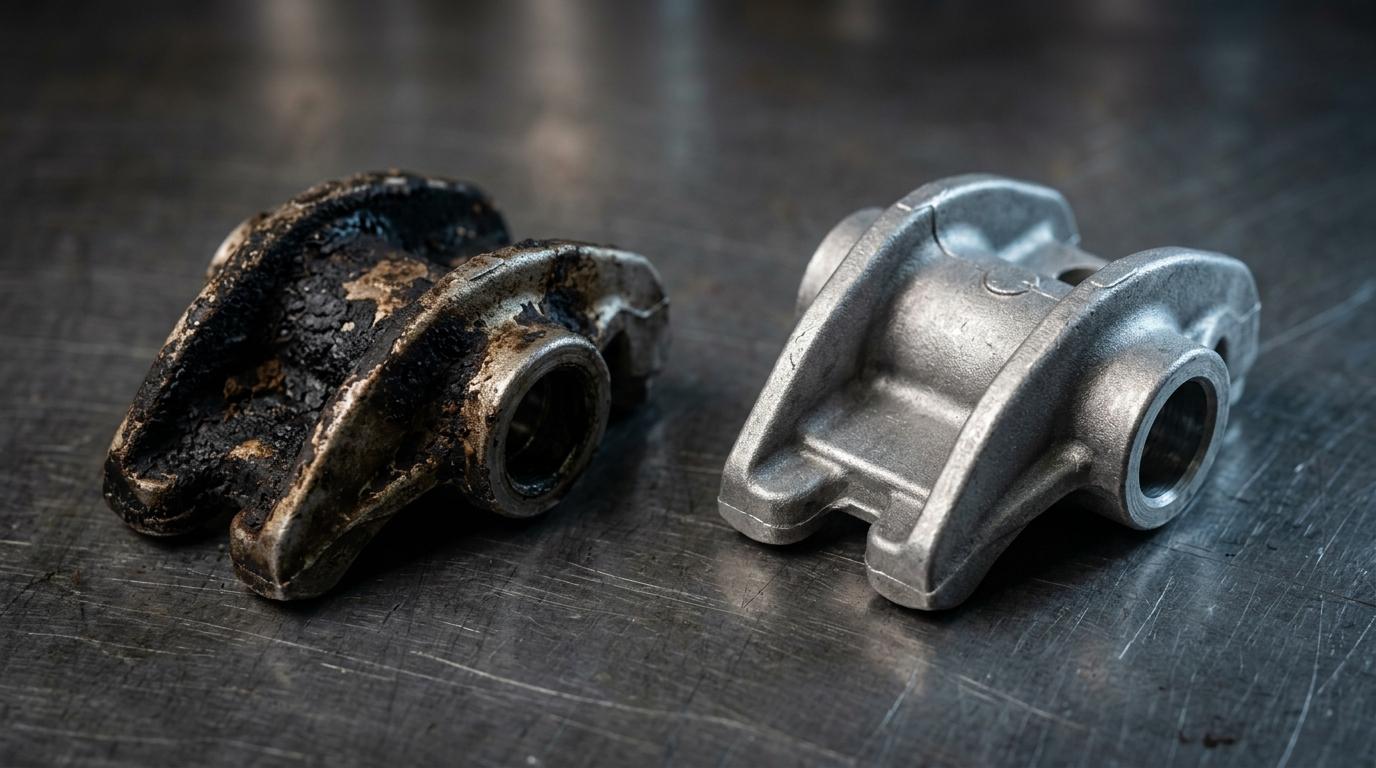
Carbon deposit is the hard, cross-linked film that forms when oil, fuel or polymer is held hot without enough oxygen to burn away. It bonds to metal and shrugs off solvents. Removal needs a chemistry that attacks the film plus 28 kHz cavitation, or electrolysis on moulds.
- Recommended frequency
- 28 / 40 kHz
Carbon deposit is what an oil becomes when it is not allowed to be an oil any more. Held above its thermal limit with restricted oxygen, a hydrocarbon does not simply burn off: it cracks, polymerises and cross-links, losing hydrogen and gaining structure until what is left is a hard, insoluble, partly graphitic film keyed into the metal underneath. Fuel gum and varnish are the same process caught earlier; coke on a turbine or turbocharger part is the same process taken further. In a mould, the source is not fuel at all but the outgassing of the plastic itself, baked onto the vent and the cavity wall.
It resists cleaning for a reason that no amount of degreaser fixes. A degreaser dissolves oil, and this is no longer oil — the solvent-soluble fraction burned off during formation, which is precisely why the deposit is there. What remains has no polar handle for a surfactant to grip and is mechanically keyed into surface roughness. It also builds in layers, so an old deposit is a stratified structure with fresh oil at the top and something close to hard carbon at the bottom, and a chemistry that lifts the top layer can stall there and look like it has worked.
The damage it does is thermal and dimensional. Carbon is an insulator, so a coked heat exchanger, oil cooler or cylinder head runs hotter, which makes more carbon. A coked injector nozzle no longer sprays a defined pattern, so the engine loses combustion quality and makes more deposit still. In a mould, gas residue on the vent stops the vent venting, which gives short shots, burn marks and dimensional drift; in a die, carbon and soldering change the cavity dimension directly. On cooking and baking surfaces, carbonised sugar and fat are both a hygiene finding and a heat-transfer problem.
Ultrasonic cleaning is the practical answer because carbon lives in exactly the places you cannot reach: the spray hole of an injector, the internal gallery of a piston, the tube bundle of a heat exchanger, the vent slot of a mould, the fin pack of an oil cooler. Manual removal there means scraping or blasting, and both change the surface — a scraped injector orifice or a blasted cavity is a scrapped part. Cavitation at 28 kHz delivers hard mechanical work everywhere the liquid reaches, and unlike a scraper it cannot cut into the base metal. A hot alkaline or specialty carbon-removal chemistry softens the outer layers so cavitation can undercut and lift the film in sheets rather than eroding it grain by grain.
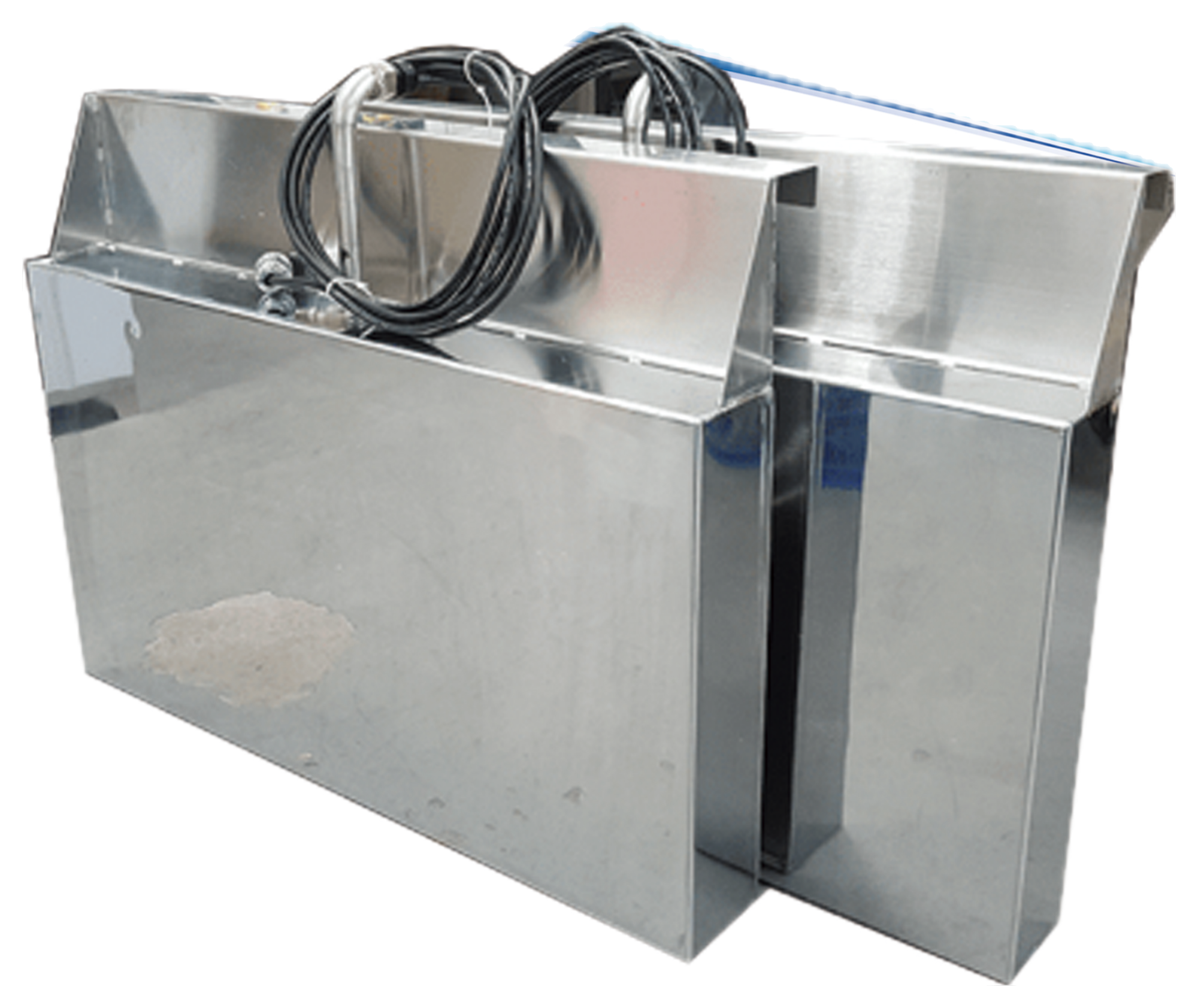
For moulds and dies specifically, LEO builds a mould electrolysis ultrasonic cleaning machine that adds an electrolytic stage to the ultrasonic one. Current through a special electrolyte decomposes the deposit and lifts it off the surface while cavitation carries it out of micro-holes and vents. LEO describes that machine as removing gas residue, carbide, sulphide, mould release agent and resin residue from the mould surface and cavity without corroding the mould body — which is the whole point on a hardened, polished tool that has to go back into the press and hold its dimension.
Process
The process chain
- Step
Hot soak to soften the outer layers
Carbon builds in strata, with fresher oil above harder deposit. A hot chemical soak works down through the soft upper layers first, so the ultrasonic stage starts against the bound film rather than spending its energy on the grease sitting on top of it.
- Step
Ultrasonic wash at 28 kHz
Low frequency produces the largest, most energetic cavitation, which is what a cross-linked carbon film needs. It reaches the injector orifice, the internal gallery and the tube bundle — the places where the alternative is scraping, and scraping is what turns a serviceable part into scrap.
- Step
Electrolytic stage for moulds and dies
On a hardened, polished tool the deposit has to come off without the base metal being touched. Current through a special electrolyte decomposes the film and lifts it, while cavitation carries it out of micro-holes and vent slots — the duty LEO built the mould electrolysis machine for.
- Step
Neutralising rinse
Carbon-removal chemistries are aggressive, and anything left in a blind gallery or a vent slot keeps working after the part leaves the tank. A rinse that neutralises as well as dilutes is what stops residual chemistry attacking the part in storage.
- Step
Dry and protect before return to service
Parts that come out of a carbon job are usually bare steel or cast iron with the protective varnish gone. Hot-air drying through the galleries, then a rust preventive on anything that will not be refitted immediately — a decarbonised mould left wet rusts in the cavity, which is a worse fault than the carbon was.
Products
Recommended equipment


Industries
Industries this serves



Frequently asked questions
Because a degreaser dissolves oil and carbon deposit is no longer oil. The soluble fraction is what burned off while the deposit was forming; what stayed behind is a cross-linked, partly graphitic solid with no polar site for a surfactant to attach to, mechanically keyed into the surface. It needs a chemistry chosen to attack that structure plus real mechanical energy — which at the bottom of an injector hole or inside a tube bundle can only be delivered by cavitation.
It is the safer option compared with the alternatives, which are scraping, wire wheels and blasting — all of which change the cavity surface, and a mould cavity surface is the product surface. Cavitation carries no solid medium and cannot cut into the base metal. LEO’s mould electrolysis machine is specified as non-corrosive to the mould body for exactly this reason. What still needs care is chemistry selection on soft, plated or textured cavities, and that is an evaluation, not a default recipe.
Cleaning removes deposit; it does not restore metal. If the spray pattern has drifted because coke has narrowed or shadowed the orifice, removing the coke addresses the cause. If the orifice itself has been eroded, or a previous cleaning attempt used a wire or an abrasive in the hole, the geometry is gone and no cleaning process brings it back. That distinction is why ultrasonic cleaning is preferred here — it is the removal method that cannot make the second problem.
Request a Quote
Tell us what you need cleaned
Send us the part, the contaminant and your cycle time. Our engineers size the tank, the frequency and the process chain — and reply with a sized specification for your line.