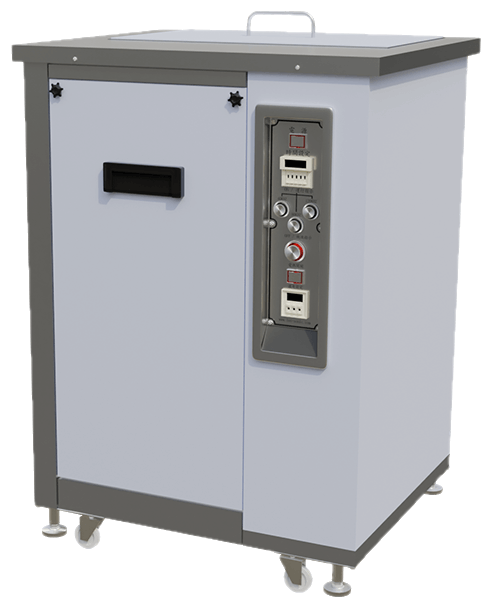
Flux residue
The rosin, activator and ionic film that wave, reflow and hand soldering leave on boards, terminals, connectors and soldered assemblies.
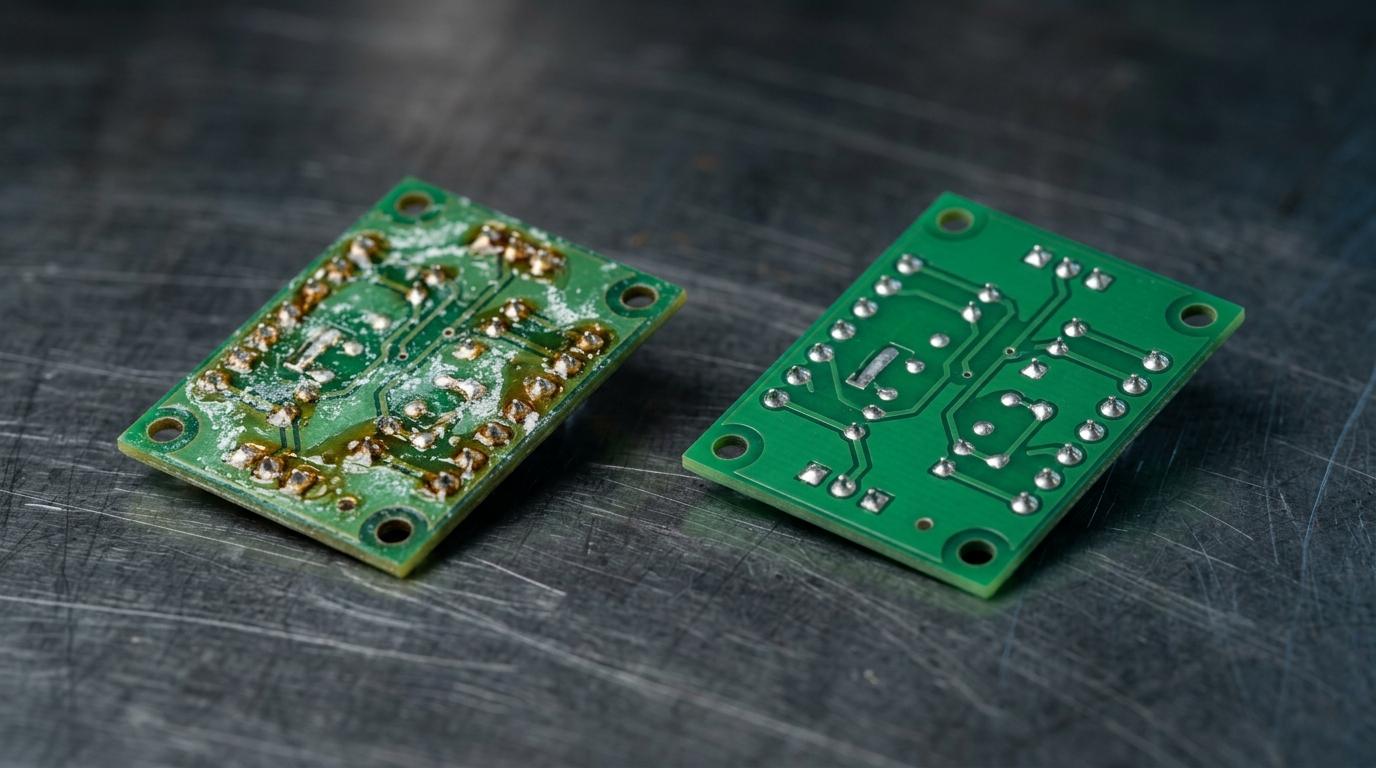
Flux residue is the activator-and-rosin film soldering leaves behind on boards, terminals and connectors. Its acidic activators keep attacking metal and its rosin traps ionic contamination, so it causes corrosion and leakage current. Ultrasonic cleaning at 40 to 80 kHz in a warm saponifier reaches under components where spray cannot.
- Recommended frequency
- 40 / 80 kHz
Flux is not a contaminant while it is working. Its job is to strip oxide off the pad and the lead at soldering temperature so the solder can wet the metal, and it does that by being chemically aggressive. The problem is that it is still chemically aggressive after the joint has formed. What remains on the board is a mixture of spent and unspent activator, rosin or resin binder, and the metal salts the activator produced while it was doing its work.
That mixture is hard to remove for two reasons. Reflow bakes it: the rosin carrier polymerises into a hard, glassy film that ordinary spray washing skims over. And the residue that matters most is the residue you cannot see or reach — under a BGA, in the 100 to 300 micron standoff beneath a chip component, inside a connector shell, between the pins of a fine-pitch package. A spray jet travels in a straight line and stops at the first obstruction. Those are exactly the places where solder paste was printed and where flux therefore pooled.
Left in place, it does three things. The unspent activator continues to corrode the pad, the lead and the plating. The rosin film is hygroscopic and holds ionic residue against the metal, which under bias grows dendrites between adjacent conductors and eventually shorts them. And it is a poor surface for anything applied afterwards, so conformal coating de-wets, adhesive fails to bond, and a subsequent rework joint will not take. In marine and outdoor electronics the failure is faster still, because salt-laden air supplies the electrolyte the residue was waiting for.
Ultrasonic cleaning solves the geometry problem. Cavitation happens throughout the liquid, so wherever the chemistry can wet, the mechanical action follows: under the component, into the standoff, inside the shell. The chemistry is a warm saponifier or a water-based specialty cleaner that converts the rosin into something water-soluble; cavitation then removes it and, critically, keeps replenishing fresh solution in the gap so the reaction does not stall in its own products. Frequency is the safety control. Populated assemblies with fine-pitch parts and bond wires run at 80 kHz or higher, where cavitation bubbles are smaller and gentler; bare boards, terminals, connector bodies and stamped conductive parts tolerate 40 kHz, which works faster.
The rinse matters as much as the wash. Flux cleaning is ionic cleaning, and a residue that is dissolved but not rinsed away simply redeposits as the part dries. That is why a flux line is built as a cascade — wash, first rinse, DI final rinse — so the last water the board touches is the cleanest water in the machine, and why cleanliness is verified by resistivity of solvent extract rather than by eye.
Process
The process chain
- Step
Pre-rinse while the flux is still warm
Boards go to the washer straight off the reflow or wave line. Flux that has not yet cooled and hardened releases far more easily than flux that has sat overnight, and the pre-rinse also carries away loose solder balls before they can be driven into a gap by cavitation.
- Step
Ultrasonic wash in a warm saponifier
A water-based specialty cleaner or saponifier at 45–60 °C converts the rosin binder into a water-soluble soap while cavitation drives fresh solution into the component standoff and removes what the chemistry has released. This is the only stage that reaches under a placed component.
- Step
Ultrasonic rinse
Dissolved flux and the cleaner that carries it are both contamination once the wash tank is left behind. An ultrasonic rinse displaces the drag-out from the same blind features the wash reached, rather than merely diluting it on the outer surfaces.
- Step
DI final rinse to a resistivity target
The last rinse is deionised water, held to a resistivity figure rather than a time. Flux cleaning is ionic cleaning: the rinse water leaving the part is the measurement, and a cascade keeps the cleanest water in contact with the part last.
- Step
Hot-air dry before any coating step
Water trapped under a component will out-gas later and blister a conformal coating, so drying is done with heated circulating air that reaches the standoff, not with a surface blow-off. Boards must be dry through their thickness before coating or test.
Industries
Industries this serves


Frequently asked questions
It can be, when frequency, power, temperature and time are chosen for the assembly rather than for the soil. Higher frequencies produce smaller, less energetic cavitation bubbles and are the normal choice for fine-pitch parts, bond wires and unsupported leads. The parts that need evaluation before a process is fixed are crystals, MEMS devices, unsealed relays, trimmer potentiometers and any component with a vented package that can take liquid in and not let it out. LEO configures the system after reviewing the assembly, not from a standard recipe.
Often, yes. No-clean means the residue is designed to be benign if it is left undisturbed and fully heated; it does not mean there is no residue. Assemblies that go on to conformal coating, underfill, wire bonding or press-fit connection frequently have to be cleaned anyway, because the residue is a poor adhesion surface. Boards for high-voltage, high-impedance, medical or marine service are usually cleaned as a reliability decision. Partially heated residue — a hand-soldered rework joint on an otherwise no-clean board — is the least benign case of all.
Bare boards, terminals, connector shells and stamped conductive parts are usually cleaned at 40 kHz, which cavitates hard enough to break a baked rosin film quickly. Populated assemblies, fine-pitch packages and anything with exposed bond wires move up to 80 kHz, and semiconductor-grade work goes to 120 kHz. LEO builds dual- and three-frequency tanks precisely because a mixed-product plant needs both ends of that range in one machine.
Request a Quote
Tell us what you need cleaned
Send us the part, the contaminant and your cycle time. Our engineers size the tank, the frequency and the process chain — and reply with a sized specification for your line.