
Mould release agent
The silicone, wax, PTFE, soap or fat film applied so a moulded part will release — and the build-up it leaves on the tool and transfers to the part.
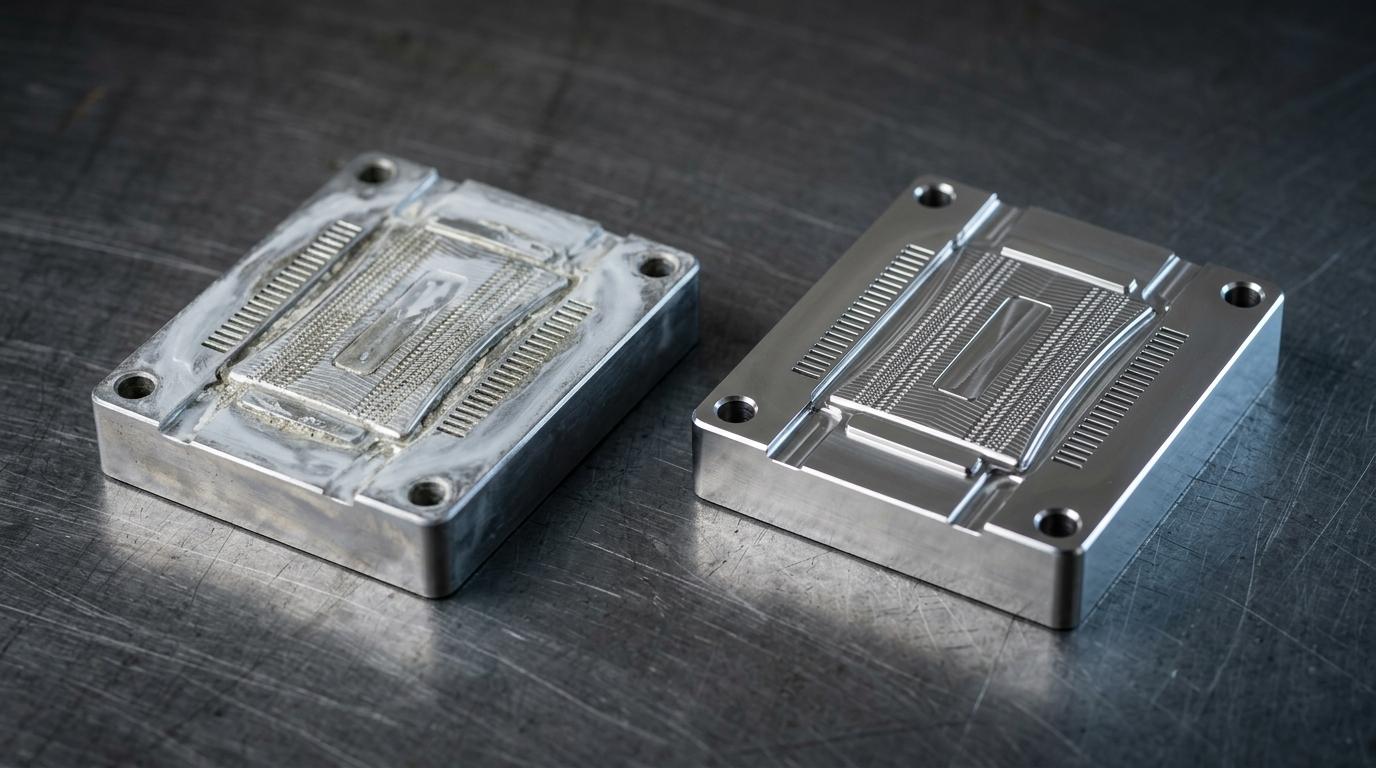
Mould release agent is the silicone, wax, PTFE or soap film sprayed into a tool so the part comes out. It transfers to both, builds up in texture and vents, and repels the water that would clean it. Ultrasonic cleaning at 28 to 40 kHz with a matched chemistry strips it.
- Recommended frequency
- 28 / 40 kHz
A release agent is a deliberate contaminant. Its entire function is to be a weak boundary layer between the tool and the part, so that when the mould opens the failure happens in the release agent rather than in the moulding. Silicone oils and emulsions, PTFE dispersions, waxes, metallic soaps and — on baking and confectionery tooling — plain fats and oils all do the same job by the same principle: they are chosen because nothing sticks to them.
That is exactly why they are hard to clean. A surface designed so that nothing adheres to it also resists the wetting that cleaning depends on; water beads and rolls off a siliconed cavity instead of spreading across it, so a spray wash simply does not make contact. The agent also does not stay where it was sprayed. Every cycle transfers some of it to the part and leaves some of it behind, and the fraction that stays is repeatedly heated. What starts as a mobile film degrades into a hard, discoloured, cross-linked deposit that fills the texture, blocks the vents and rounds off the edges the tool was cut to hold.
The failures show up on both sides of the interface. On the tool: blocked vents give short shots, gas burn and dimensional drift; filled texture gives a flat, greyed surface finish that no polishing schedule restores while the deposit is still in it; and the release agent that has degraded stops releasing, so operators spray more, which builds up faster. On the part: transferred release agent is why paint craters, why print and hot-stamping foil lifts, why adhesive and over-moulding bonds fail, and why plating skips. Silicone is the worst offender because it migrates and contaminates other work in the same shop, and because the amount needed to ruin a paint job is far below the amount you can see. On cast optical lenses it shows as a haze in the surface; on food tooling, degraded fat and release agent is a hygiene finding as much as a process one.
Ultrasonic cleaning changes the problem from a wetting problem into a mechanical one. Cavitation does not need the surface to be wettable in the way a spray does — bubble collapse at the interface breaks the film locally, and once the film is broken the chemistry can get under it and lift it. The chemistry has to be matched to the agent: waxes and fats respond to a hot alkaline degreaser, while cured silicone and PTFE build-up need a solvent or specialty cleaner chosen for them. LEO develops its cleaning agents in-house against specific process requirements for exactly this kind of case, where an off-the-shelf degreaser and the actual soil are not talking to each other.
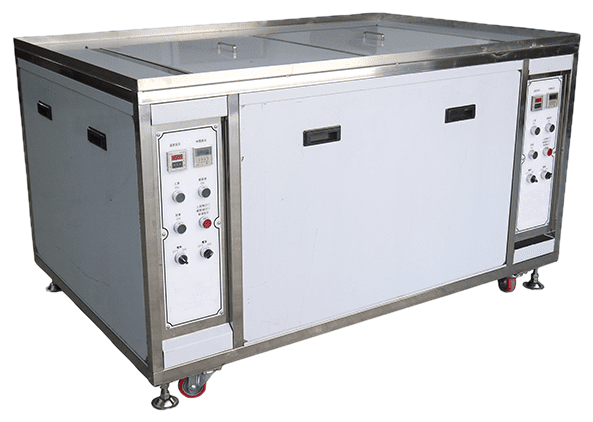
For injection, blow and stamping tooling LEO builds the mould electrolysis ultrasonic cleaning machine, whose published removal list names mould release agent alongside gas residue, carbide, sulphide, resin residue and toner residue — the whole mixed deposit a working cavity accumulates. It is specified as non-corrosive to the mould body, which is the constraint that rules out most of the alternatives: a polished or textured cavity that has been wire-wheeled or blasted has had its surface, and therefore the product surface, changed permanently. Baking and confectionery moulds, where the release film is fat rather than silicone, are a different chemistry but the same geometry problem, and LEO has built dual-tank and ultrasonic dishwashing equipment for that duty.
Process
The process chain
- Step
Cool the tool and remove bulk residue
A mould goes into the tank cool and with loose flash, purge and sprue debris already off it. Bulk material in the bath shortens the chemistry’s life and shadows the cavity from cavitation, and a hot tool quenched in cold liquid is a thermal-shock risk in its own right.
- Step
Ultrasonic wash in a chemistry matched to the agent
Waxes, soaps and fats go into a hot alkaline degreaser; cured silicone and PTFE build-up need a solvent or specialty cleaner selected for them. Cavitation breaks the non-stick film locally so the chemistry can get underneath it — which is what a spray wash on a siliconed surface never manages.
- Step
Electrolytic stage on hardened tooling
On injection, blow and stamping tools the deposit is a mixture — release agent, gas residue, carbide, resin — and it sits in texture and vent slots. An electrolytic stage decomposes and peels it while cavitation carries it out, with no medium that can alter the cavity surface.
- Step
Rinse and verify the vents
Vent slots are the feature that fails first and the feature that is checked last. The rinse has to clear the loosened deposit out of them rather than flush it further in, and the tool is checked for vent clearance before it goes back in the press, not after the first short shot.
- Step
Dry and oil before storage
A stripped cavity has no release film and no rust preventive on it, and a mould stored wet corrodes in the one place that matters. Hot-air drying followed by a preservative appropriate to the next moulding material is the last step of the job, not an optional extra.



Industries
Industries this serves

Frequently asked questions
Because a release agent is chosen for being non-wetting, and a spray wash depends entirely on wetting. Water beads on a siliconed surface and runs off it, so the detergent never spends time in contact with the film it is supposed to attack. Cavitation does not need the surface to spread the liquid — bubble collapse breaks the film at the interface and gives the chemistry a way underneath. That is the mechanism difference, and it is why the same detergent that fails in a spray cabinet works in an ultrasonic tank.
Before the deposit changes the part, not after. The useful signal is not appearance but process drift: rising short-shot rate, gas burn appearing at the end of fill, texture going flat, release getting harder so operators spray more. Each of those is the vent or the cavity telling you it is filling up. Cleaning on a cycle count tied to the material and the tool is cheaper than cleaning on a defect, because by the time the defect appears the deposit has already been baked on for thousands of cycles.
The risk is in the method, not in the cleaning. Wire wheels, scrapers and blasting all change the cavity surface, and on a mould the cavity surface is the product surface — that is irreversible. Ultrasonic and electrolytic cleaning carry no solid medium, and LEO specifies the mould electrolysis machine as non-corrosive to the mould body. What still needs judgement is chemistry selection on plated, coated or soft cavities, and running time: any process left on far longer than it needs to be is a different conversation from the process itself.
Request a Quote
Tell us what you need cleaned
Send us the part, the contaminant and your cycle time. Our engineers size the tank, the frequency and the process chain — and reply with a sized specification for your line.